


Is Your Manufacturing ERP Giving You the Full Picture?
A customer asks when an order will ship. Sales checks one system, production checks the schedule, and purchasing looks into a delayed part. If those answers do not match, a simple question can turn into a long chain of calls and emails.
That is the problem a manufacturing ERP is meant to help solve.
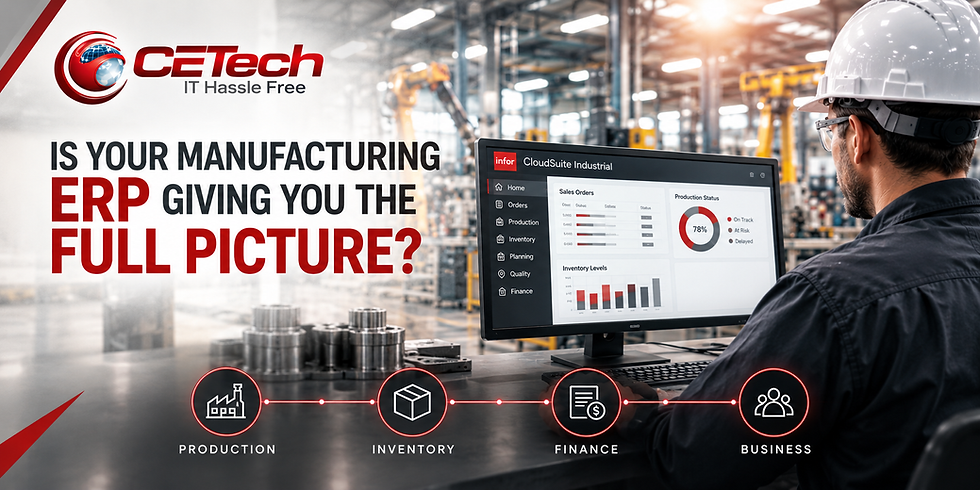
Infor SyteLine, also known through its cloud evolution as Infor CloudSuite Industrial, brings important manufacturing processes together. It can help teams work with information about orders, inventory, planning, production, quality, and finances in one connected environment.
But having an ERP does not automatically mean everyone is getting the answers they need. If information is entered late, processes happen outside the system, or employees cannot find what matters to their role, the business can still end up relying on spreadsheets and guesswork.
Here are five ways manufacturers can get more value from their ERP.
1. Start With the Questions Your Team Needs to Answer
Before adding a dashboard or changing a workflow, ask what information is difficult to find today.
For example:
Can sales give a customer a reliable order update?
Does purchasing know which materials are needed for upcoming jobs?
Can production see when a schedule change affects other orders?
Can leadership identify where costs are rising?
The answers will show where information is missing, delayed, or spread across too many places.
Start with a few decisions that matter every day. Then look at whether your ERP gives the right people the information to make them.
2. Make Inventory Data Reliable
An ERP can only help with planning if the inventory records reflect what is actually available.
When quantities or locations are wrong, teams may order materials they already have, schedule work around parts that are missing, or discover a shortage after a job has started.
Review how your company handles these matters:
Materials received from suppliers
Parts moved between locations
Materials used during production
Scrap, rework, and returns
Finished goods ready to ship
If employees routinely correct inventory outside the ERP, find out why. The issue may be an unclear process, a delay in entering transactions, or a workflow that does not match what happens on the floor.
Better inventory visibility begins with consistent habits.
3. Connect Scheduling to What Is Happening on the Floor
A production schedule can change quickly. A supplier shipment arrives late. A machine needs maintenance. A priority order comes in.
Your team needs to understand how those changes affect available materials, work in progress, and delivery dates.
SyteLine includes planning and scheduling capabilities designed for manufacturing operations. The practical question is whether the people making decisions are using current information.
Ask your team:
When a job changes, who updates the system?
Can planners see material or capacity constraints before committing to a date?
Do employees know which schedule is current?
How are changes communicated to purchasing and sales?
A connected process helps teams spot conflicts earlier and give customers more dependable answers.
4. Give Each Department a Useful View
The person planning tomorrow’s production does not need the same screen as someone handling customer orders or reviewing financial results.
Infor describes role-based views, dashboards, and reporting within SyteLine. Manufacturers can use these tools to put relevant information in front of each team.
For a production manager, that might mean open jobs and scheduling priorities. Purchasing may need supplier delivery information and material requirements. Leadership may want to see inventory trends, costs, and on-time delivery.
A useful dashboard should answer a real question. If employees still export data and build their own reports every morning, ask what the current view is missing.
5. Review the Processes Happening Outside Your ERP
Spreadsheets and email are useful tools. But when they become the only place where a key decision or update is recorded, the rest of the business may be working from incomplete information.
Look for processes such as order changes, quality issues, purchasing approvals, or production updates that happen outside SyteLine.
You do not need to change every process at once. Choose one that regularly causes confusion, document how it works today, and decide what information should be captured in the ERP. Then train the employees involved and check whether the new process is working.
Turn ERP Data Into Better Decisions
A manufacturing ERP is most valuable when people trust the information in it and use it to coordinate their work.
Start by identifying the questions your team struggles to answer. Then review inventory accuracy, scheduling practices, dashboards, and the processes still happening outside the system. Small improvements in these areas can give employees a clearer view of what is happening across the business.
Your ERP also depends on reliable access to the systems and devices your team uses every day.
CETech helps manufacturers support their IT environment so employees can stay connected and focused on production.
Want to talk about the technology supporting your manufacturing operation?
Or call 585-441-0055.


Comments